The End of Reactive Support
How proactive post-purchase engagement can prevent returns, convert refunds to exchanges, and build customer loyalty in e-commerce.
 Ilya Valmianski
In 2010, a company providing customer support meant hiring people, setting up a call center, and dealing with high-churn, inconsistent reps. Especially in tech, many companies opted to forgo actual customer support (try getting a real reply from Google!) and just pushed people into figuring things out via FAQs and community forums. For e-commerce, this meant high costs, a poor customer experience, and a general trend towards “frictionless returns” with few clicks but little opportunity to actually improve the situation.
That scarcity shaped how customer experience was designed. Customer support became impersonal by necessity. The standard interaction was a support ticket or an email form, answered when someone got around to it. Customers learned to wait until they were genuinely frustrated before reaching out, because contacting support felt burdensome and unlikely to yield meaningful help. Brands, in turn, treated every incoming message as a cost to be minimized rather than a relationship to be maintained.
Now, AI is resetting the economics. Companies like Sierra and Decagon are building agents that can handle customer conversations and take action within real systems, the kind of work that used to require large teams and extensive training. Marginal interactions are getting cheaper and faster, and for the first time in e-commerce history, it is realistic to offer something that resembles “a helpful associate” to every customer, not just to those who complain the loudest.
And yet, most of the industry is rebuilding the same old thing with new machinery. Most implementations simply attach AI to the existing ticket queue. Brands celebrate faster response times and higher deflection rates, but the underlying model remains unchanged: customers must still initiate contact, describe their problem, and reach a threshold of frustration before anyone pays attention. The fundamental design of support, built around scarcity, persists even as the scarcity itself disappears.
The problem is that dissatisfaction rarely begins at the moment a ticket is created. The ticket is the final step, not the cause.
- No touchpoint
- Doubt festers
- Decision hardens
- Check-in text
- Concern shared
- Personalized help
Returns are a big problem.
The National Retail Federation (NRF) and Happy Returns projected that U.S. retail returns would total $890 billion in 2024, or 16.9% of annual sales. In the same report, 76% of consumers said free returns are a key factor in deciding where to shop. Many high-end apparel brands have returns rates higher than 30%.
These facts put retailers in a difficult position. Customers now expect returns to be easy and free, but each return directly erodes margin and consumes operational resources. When retailers respond by tightening policies, adding fees, shortening return windows, or pushing store credit instead of refunds, customers get justifiably upset. The brand pays for this later through lower repeat purchases and higher customer acquisition costs. NRF has also reported that 67% of consumers say a negative return experience would discourage them from shopping with that retailer again.
It is tempting to blame customers for high return rates, to talk about policy abuse and bracketing run amok. While this is sometimes accurate (many, many customers buy multiple sizes, generating unavoidable returns), a more useful framing for apparel is that most returns stem from incomplete information. The customer did not know how the garment would fit her body, how the color would look in her lighting, how the fabric would feel against her skin, or whether the small imperfection she noticed upon arrival was a normal variation or an actual defect. She discovers these answers at home, and in that moment, she forms her opinion of whether the brand understands her.
In apparel, returns are often not driven by quality.
Apparel returns are usually not due to catastrophic problems. The leading cause is fit; the garment simply does not work on the customer’s body. After that comes appearance, when the color or style looks different in person than it did online. PowerReviews found that 39% of consumers return apparel because it doesn’t fit, and 28% return it because it didn’t look as expected. Some of the brands we talked to reported that fit was responsible for up to 60% of their returns.
This has a significant economic impact. Radial estimates that merchants pay an average of $27 to process a return for a $100 e-commerce order, and that only 30% of returned merchandise is resold, with the rest going to donation, liquidation, or disposal. The cost of a return extends far beyond the refund itself. Each returned item must be shipped back, received, inspected, and either repackaged for resale or written off entirely. The operational burden is significant, and much of the returned inventory never recovers its original value.
Apparel brands, therefore, face a difficult tradeoff. Generous, frictionless return policies reduce hesitation at checkout and support conversion. But if you wait until a customer has already decided to return, you have already lost. At that point, any outreach feels like resistance, and the customer walks away feeling that the brand cared more about its margins than about her.
That is why timing matters. The best moment to help is before the return decision crystallizes.
What if the brand spoke first?
Signals exists because we believe the industry is focused on the wrong problem. The goal should not be to process tickets more cheaply. The goal should be to reach customers earlier, while their dissatisfaction is still forming, while they still want the item to work out, and while the brand can still offer help without sounding defensive. After all, the customer bought the item for a reason. Before she concludes it was a mistake, she is hoping it will work out.
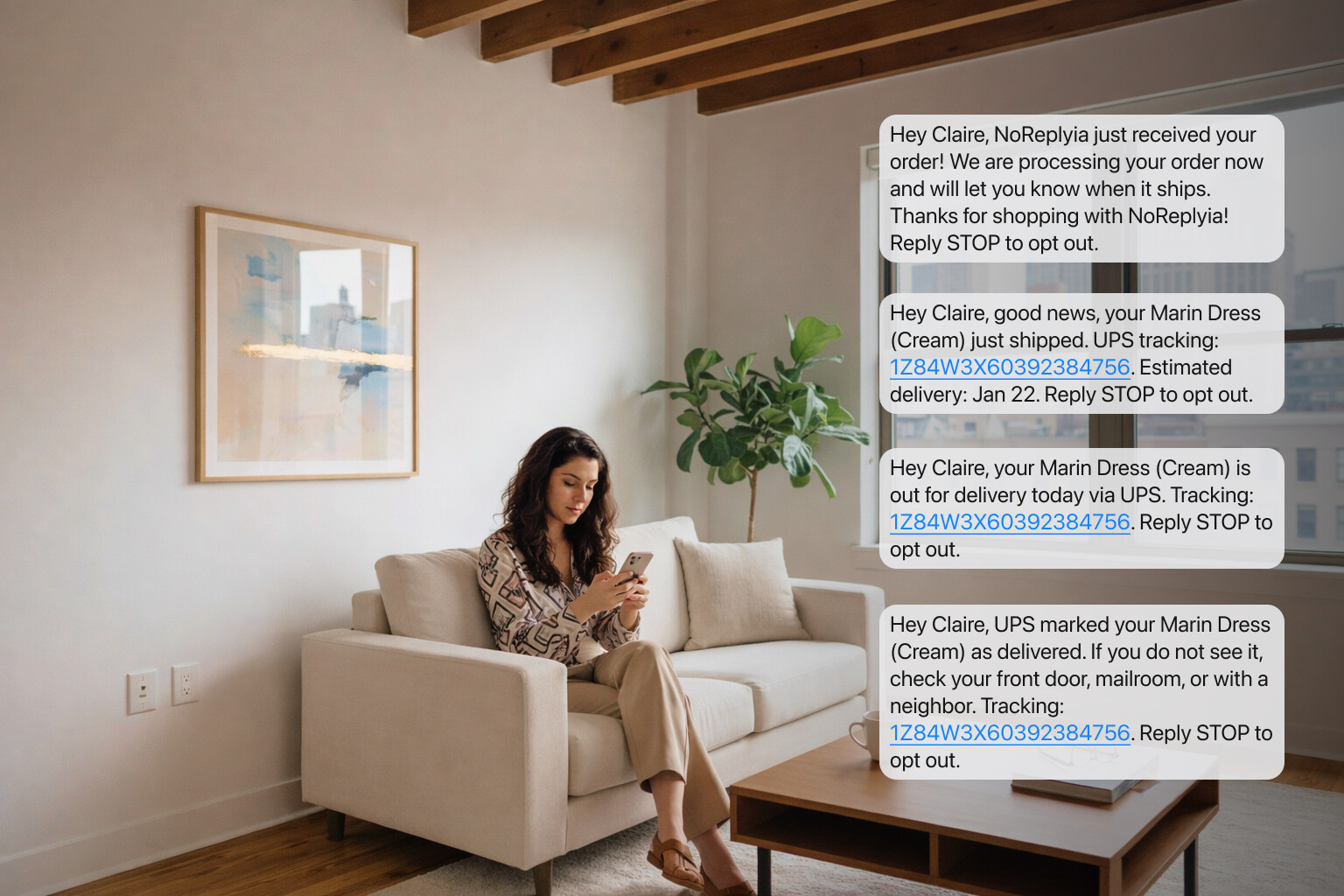
Signals works by texting the customer after delivery, checking in like a real associate would, following up if they have not tried the item yet, and resolving issues in-thread with fit guidance, styling help, and tailored exchange recommendations. When customers share photos, we can quickly compare what they are experiencing against the product catalog to find solutions that actually work. This also helps with reverse logistics: we can recommend restocking when it makes sense, rework when the issue is fixable, and sometimes suggest the customer keep the item when shipping it back would cost more than anyone would gain.
Consider the moment your existing systems miss.
A customer orders a dress for an upcoming event. It arrives a few days later, but life gets in the way, and she does not try it on right away. By the time she finally opens the package, her event is close, and she is already a little anxious. If the dress does not fit perfectly, her instinct will be to return it and find something else.
This is where proactive outreach changes the outcome. A simple check-in after delivery reminds her that someone is paying attention. If she mentions she has not tried it on yet, we follow up later. When she finally puts it on and notices that the neckline does not sit quite right, she does not have to navigate a returns portal or write a formal complaint. She can just reply to the text, describe what she is seeing, share a photo if it helps, and get a real answer. Maybe a small adjustment fixes the problem. Maybe the garment is designed to fit that way. Maybe she needs a different size or a different cut altogether. The point is that she gets help while she still wants the dress to work.
Customers are skeptical of AI in customer service.
One reason proactive concierge matters is that customers are increasingly skeptical of automation in customer service, and for good reason. A lot of AI-first support has been deployed as a gatekeeper rather than a helper.
Gartner reported that 64% of customers would prefer companies not to use AI for customer service, and that 53% would consider switching to a competitor if they found out a company was going to use AI for customer service. But really, the concern is not that “AI exists”; rather, they fear that AI is just another obstacle between them and the real help they need.
Proactive concierge changes that emotional framing. The customer is not fighting their way into a system. The brand is showing up early and offering assistance in a channel that feels natural and low effort. If you do it well, it reads less like automation and more like attentiveness.
The ROI story is not one story; it is three.
Brands often talk about returns as if the only win is “prevent the return.” Prevention is valuable, but it is not the only lever that matters, and it is not always the right lever. At Signals, we think about three kinds of value: converting returns into exchanges, preventing returns by helping customers keep the item, and improving retention by making customers feel heard and helped.
First, many unhappy customers still want the item they bought; they just believe something is wrong with it. The fit is off, the color looks strange, the fabric feels different from what was expected. If you can find a version that actually works for them, you do more than convert a refund into an exchange and preserve revenue. You help them achieve what they wanted when they placed the order in the first place. They get an item they love, and they feel cared for by the brand.
Second, some returns are avoidable because the underlying issue is confusion, not dissatisfaction. The customer may need help adjusting the waistband, understanding how lighting changes the appearance of fabric, or recognizing what is normal variation for a material. When you provide that guidance early, the customer often keeps the item and feels like they have been helped. This is good for both the customer and for the brand, which protects margin by keeping the sale and eliminating return processing costs.
Third, there is retention, the outcome that many teams undercount because it does not appear on the day the return is created. HBR cites Bain suggesting that increasing customer retention rates by 5% increases profits by 25% to 95%, depending on the business. Narvar reported that 70% of consumers say an easy return or exchange is likely to make them a repeat customer. Post-purchase resolution is one of the clearest moments when a brand can either earn another purchase or quietly lose it.
Calculate Your ROI
Four numbers you already know. The result is the extra repeat revenue per year.
The bet Signals is making.
E-commerce leaders have spent the last decade optimizing the front of the funnel, and it worked. Better PDPs, better merchandising, better checkout, faster delivery. But the customer’s relationship with an apparel brand often begins after delivery, when they try something on and decide whether the brand understands them.
AI is making support cheaper. That part is obvious. What is still underappreciated is that when support becomes abundant, you can redesign the experience around timing rather than defense.
Signals is built on the belief that the next competitive advantage in apparel lies in proactive post-purchase engagement: reaching customers before they have firmly decided to return, when help can still feel like genuine care rather than an obstacle. The financial case rests on three outcomes: converting refunds into exchanges that preserve revenue, helping customers keep items they would have returned for minor or fixable reasons, and improving retention by turning a potentially negative experience into a positive one. The brand benefit is harder to measure but equally important. When customers feel that a brand is attentive and responsive, they are far more likely to come back. In apparel, where fit and personal preference introduce inherent uncertainty, that sense of being understood often determines whether a customer writes off the brand or gives it another chance.
The best time to help a customer is before they decide they need to return. That is what we do.