Memory turns a post-delivery text thread into a revenue channel
A post-delivery text thread that remembers the exchange, the gift recipient, and the product a customer was already eyeing stops being a delivery check-in and starts earning revenue, conversation after conversation.
 Ilya Valmianski
“Hi Olivia! I LOVE the striped tee but it’s a little tight; how do I exchange for a large?”
“Hi!! I love it. I haven’t given it to the person I purchased it for yet, so I’m hoping it will fit him!”
“Btw, do you have favorite items?”
Those are three replies to three separate Signals check-ins. One customer needs an exchange, another is thinking through a gift they haven’t handed over yet, and the third wants to know what the brand thinks is worth buying next. In an ordinary ecommerce stack, every one of those requests would get routed to a different team’s inbox and never meet the other two. The customer doesn’t see any of that happening behind the scenes. They texted one number and expect whoever is on the other end to help.
What jumped out most was how much work the thread ended up doing once people replied. A conversation that started as a simple “how did the delivery go?” could shift into a return request by the second message and a cross-sell by the third, with a piece of product feedback tucked somewhere in the middle. And because Signals kept remembering each piece, the next check-in a month later didn’t start from scratch. It picked up where the last one ended.
First, the thread has to feel alive
“Thank you Olivia! I just got home and tried on the shirt. Love the fit and will keep it.”
“I love that you texted to ck on tops!! They are perfect and will definitely be ordering more colors!!”
More than half of the first replies said “thanks.” 24% said “love.” and 18% mentioned “Olivia” (our bot persona) by name. Throughout the vast majority of our conversation, it was clear that customers treated us as a person, not just an outbound campaign.
Even customers who suspected automation still answered like they were texting a person. “Hey sorry, figured this was automated. Got the hat yesterday, it’s great, thanks for checking in!” Once the thread feels alive, the customer uses it.
A thread that feels alive is the preamble to every reorder, upsell, and exchange that follows. And this is how Signals starts building a memory of the customer, one warm reply at a time. They mention a spouse they’ve been shopping for; Signals remembers. They mention a trip they’re packing for; Signals remembers that too. By the time the next check-in lands, the conversation has a history, and the longer that history runs, the less it feels like a brand reaching out and the more it feels like an old acquaintance keeping in touch.
One message often does 2 jobs
Half the replies that flagged an issue still included a “thanks” or a “love it” in the same message. Customers write what’s on their mind, and in a real conversation, it turns out people don’t separate the complaint from the compliment. They arrive together, in the same sentence, because the customer is answering a friend who just asked how the tee fit.
One message often does 2 jobs
Patricia opens the thread with an exchange request. She loves the tee, but the size is wrong. 9 days later, Patricia’s exchanged tee gets delivered. Signals already knows she swapped for the large, so when it checks back in, it doesn’t ask her to re-explain anything; it just asks if the large fits better. Patricia answers by asking for a tee for her husband, and when she confirms the size Signals provides the link to buy the second item. The thread remembered the first conversation and picked up where it left off, so a customer who could easily have become a refund turned into a retained sale plus a cross-sell, all inside the same warm thread that started with a fit complaint.
The customer’s living a life
Because this is in an iMessage thread rather than a chatbot in an app or on a website, customers don’t feel pressured to reply immediately; instead, Signals fits into their schedule. They reply when the product is physically in their hands, and they’ve had a minute to think about it. In fact, about half of our eventual replies come from a follow up ping (about 24 hours later), rather than our initial outreach.
Gift and spouse threads are the clearest example of where the memory aspect is most valuable. About 1 in 10 replied threads involved somebody other than the purchaser as the actual wearer. Someone’s buying for a husband, or a teenage son, or a friend whose birthday is still three weeks out. In practice, Signals ends up managing purchases for two or three people inside a single thread, keeping each person straight. Once the context is stored, Signals can come back weeks later to ask how the gift landed and continue the relationship.
The customer is living a life
This is what ecommerce systems usually miss. The customer’s using one thread to bring the brand into their life as it’s actually happening, on their schedule and around whatever else they’re doing that day. Every other channel makes the customer come to it. The thread comes to the customer, and it shows up already knowing who they’re shopping for and when the gift has to be ready.
The thread has a memory
Think about what this thread is quietly collecting. One week the customer mentions their size, the next they volunteer that they’re buying for a birthday at the end of the month, and a few weeks later they admit the last jacket ran tight in the shoulders. None of it feels like data at the moment it’s shared, but all of it gets remembered. By the time a new order or a new check-in lands, there’s already a running record of who the customer is and what they care about, and the next message picks up from exactly where the last one ended.
When Signals follows up with Patricia, it already knows she exchanged for a large and that she bought a second tee for her husband. When it checks in with Linda, it already knows there’s a gift recipient who hasn’t received the cap yet. When a new order comes in from Roy, it already knows which size was the mistake and which one fit his wife. The customer never has to re-explain anything. The brand never has to guess.
That memory is what turns individual check-ins into a relationship. It’s also what makes upsell and cross-sell land the right way. “Hey, you mentioned you wanted something thinner for summer, the linen version just dropped” reads like a friend who was paying attention, and that’s because the thread actually was.
The thread turns into a revenue channel
Over 20% of replied threads end up discussing another product, a restock, or something the customer is planning to buy next. Those are the chattiest threads in the whole dataset, because excited customers keep talking, and what they’re excited about is usually the next thing they want to own.
A lot of that intent arrives in the first reply. One customer will ask whether a piece comes in a darker wash. Another will mention a jacket she’s been eyeing on the site but hasn’t pulled the trigger on. The important part is that these are products the brand actually sells today, in a size the thread already knows the customer wears. Signals doesn’t have to invent a recommendation; it just has to match what the customer said to what’s in stock, and come back a week later when the moment is right.
The thread turns into a revenue channel
By that point, the thread’s doing direct revenue work. A customer will casually mention another product one week, and place a reorder the next. Because the thread remembers both conversations, Signals can come back days later and close the upsell it first heard about unprompted. Across replied conversations, 13% mentioned reorder plans and 9% asked about products the customer hadn’t bought yet. That’s real buying intent showing up on its own, from customers already holding the product, and most brands pay Klaviyo and Attentive real money trying to surface the same signal.
The revenue impact
The thread generates real revenue, and it’s measurable.
In a randomized experiment with Quaker Marine, customers reached on iMessage and RCS replied 58% of the time. Treatment customers repurchased 16% more often than control within 3 weeks. Among customers who actually engaged in conversation, repeat purchase lift was 51%.
Those numbers make sense once you read the conversations. The lift comes from a thread that picks up where it left off, leaning on what it remembers from three weeks ago. A sizing problem that would have hardened into a refund turns into an exchange instead, because the conversation catches it before it escalates. A customer mentions they’re eyeing a new product today, and a week later Signals comes back with it in hand. None of that is a single well-timed message; it’s a relationship unfolding inside the same window where the shipment notifications used to go quiet.
What’s worth holding onto is that the customer kept using the same thread as the work changed. Every exchange, every gift question, every reorder, every stray piece of product feedback went into the same running record, and the brand came back to each one knowing everything it had already been told. That’s the difference between a delivery check-in and a revenue channel.
Returns still belong in the same thread
Laurie never had to re-explain herself in a portal, a ticket, and a marketing system. The same thread that opened with a check-in became the place where the return could actually start.
Memory and a long-lasting thread enables a new revenue channel for DTC brands
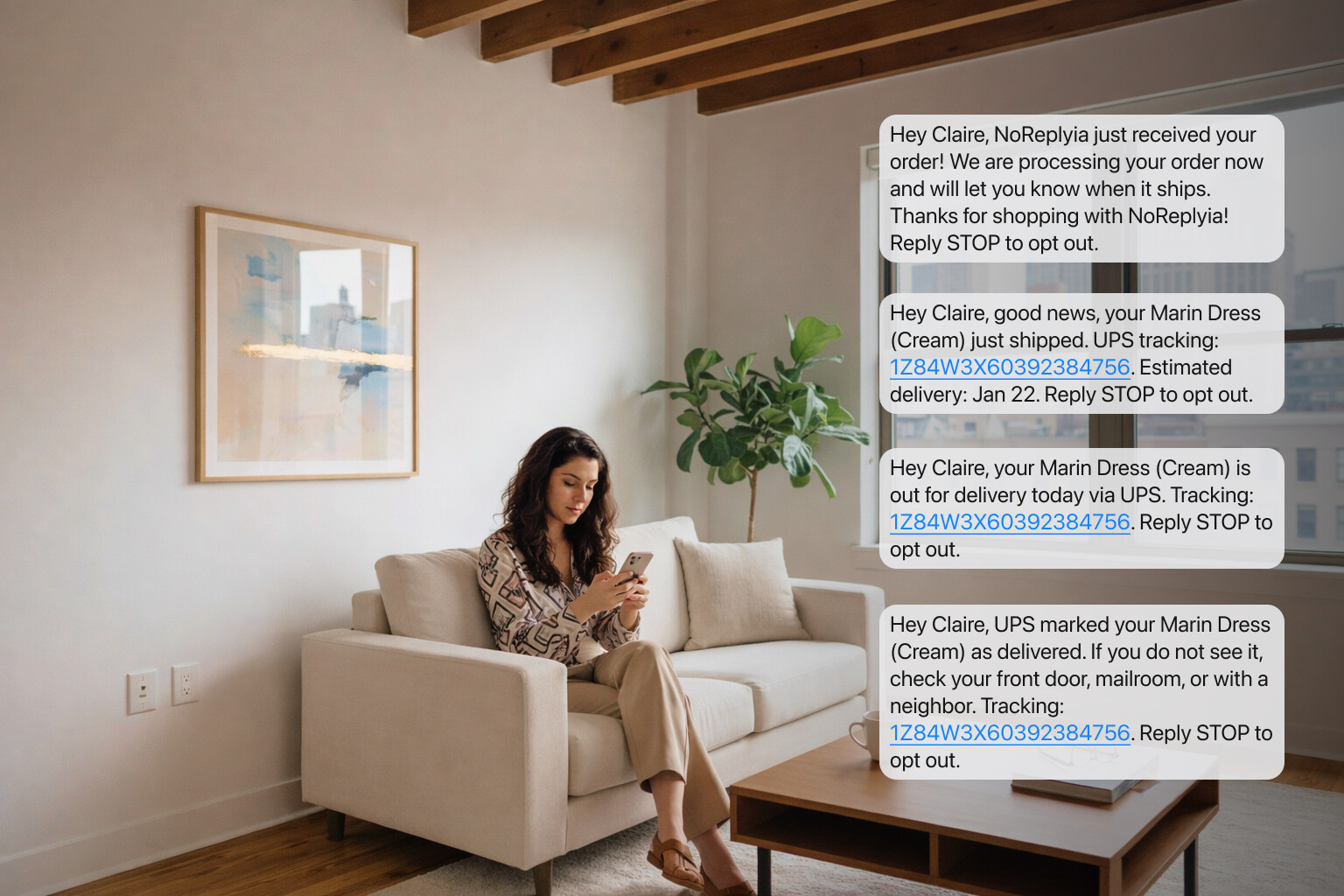
DTC brands already own the rarest asset in ecommerce: a direct line to every customer who’s ever bought from them. The trouble is that the line usually goes quiet the moment the package lands. Most brands spend the week before delivery reaching out over Shopify notifications and the week after delivery quietly hoping the customer comes back on their own.
A post-delivery text thread changes that, but only when the thread is allowed to live. The same thread that handled Patricia’s exchange last month is still holding everything it learned along the way, so the next time Signals has a reason to reach out, it already knows she bought for herself and for her husband and doesn’t have to start over. That kind of continuity is what turns a one-off check-in into a relationship, and it runs inside the same channel the brand was already paying to send shipment updates into.
The revenue shows up in the numbers. In the Quaker Marine experiment, engaged customers repurchased 51% more often than control in the first three weeks alone, and that lift came from the same threads that earlier handled the exchanges and the gift questions. Every conversation the thread remembered made the next one easier to earn.
If the post-delivery thread stays one-way, it’s just logistics. If it remembers, it becomes the richest revenue channel a DTC brand already owns.
If you want to see this kind of thread running on your own post-delivery window, book a demo and we’ll walk through what it would look like for your brand.