OpenAI and Gemini on 36 commerce tasks
We tested GPT-6.1 Terra, GPT-6.2 Sol, Gemini 4 Neon and Hydrogen on 36 shopping, returns and support tasks, comparing pass rates, cost and latency with earlier Gemini runs.
 Ilya Valmianski
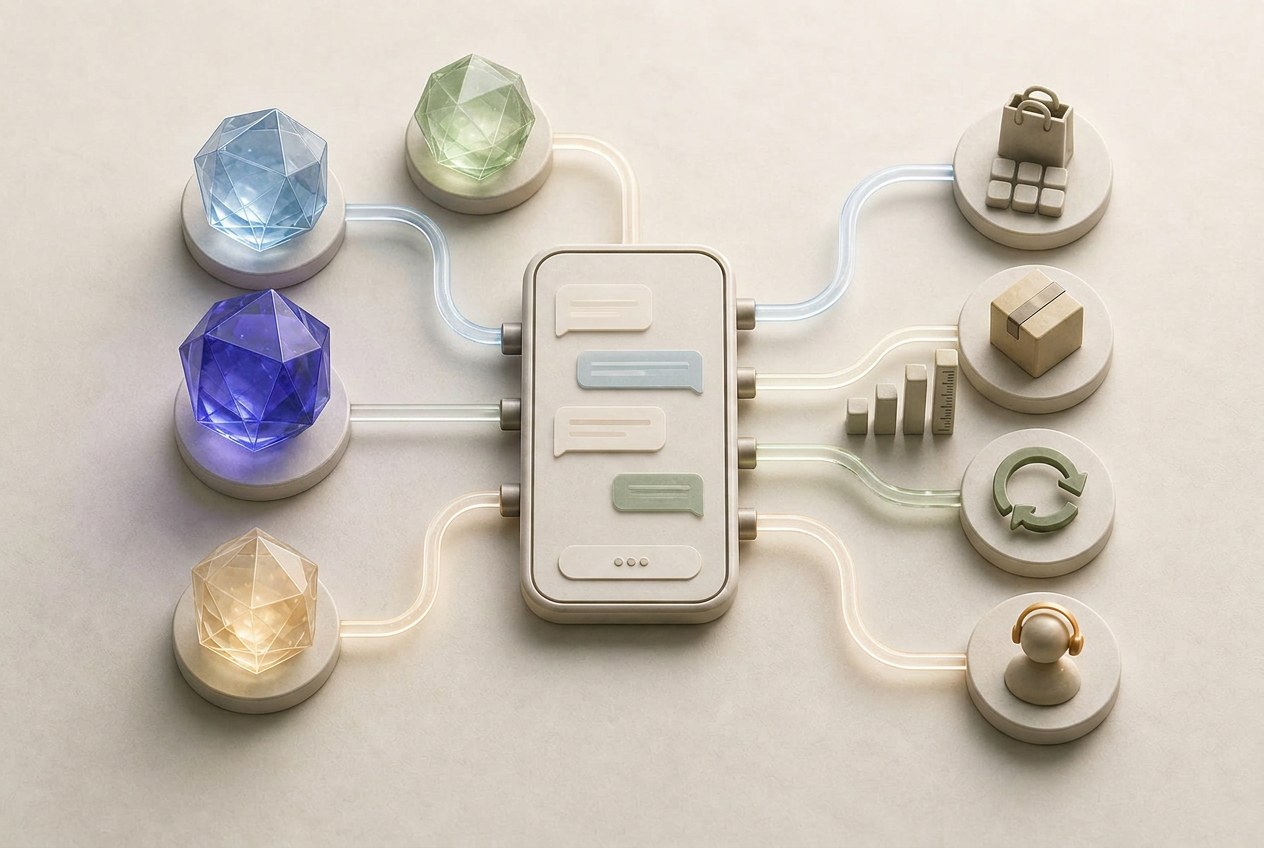
Our agent helps shoppers over iMessage, from questions before they buy to check-ins after their orders arrive. It looks up products and orders, handles return requests and brings in a person when needed. Before we adopt a new model, we run it on a fixed set of tasks drawn from that work, so we can compare quality, cost and speed on the same footing.
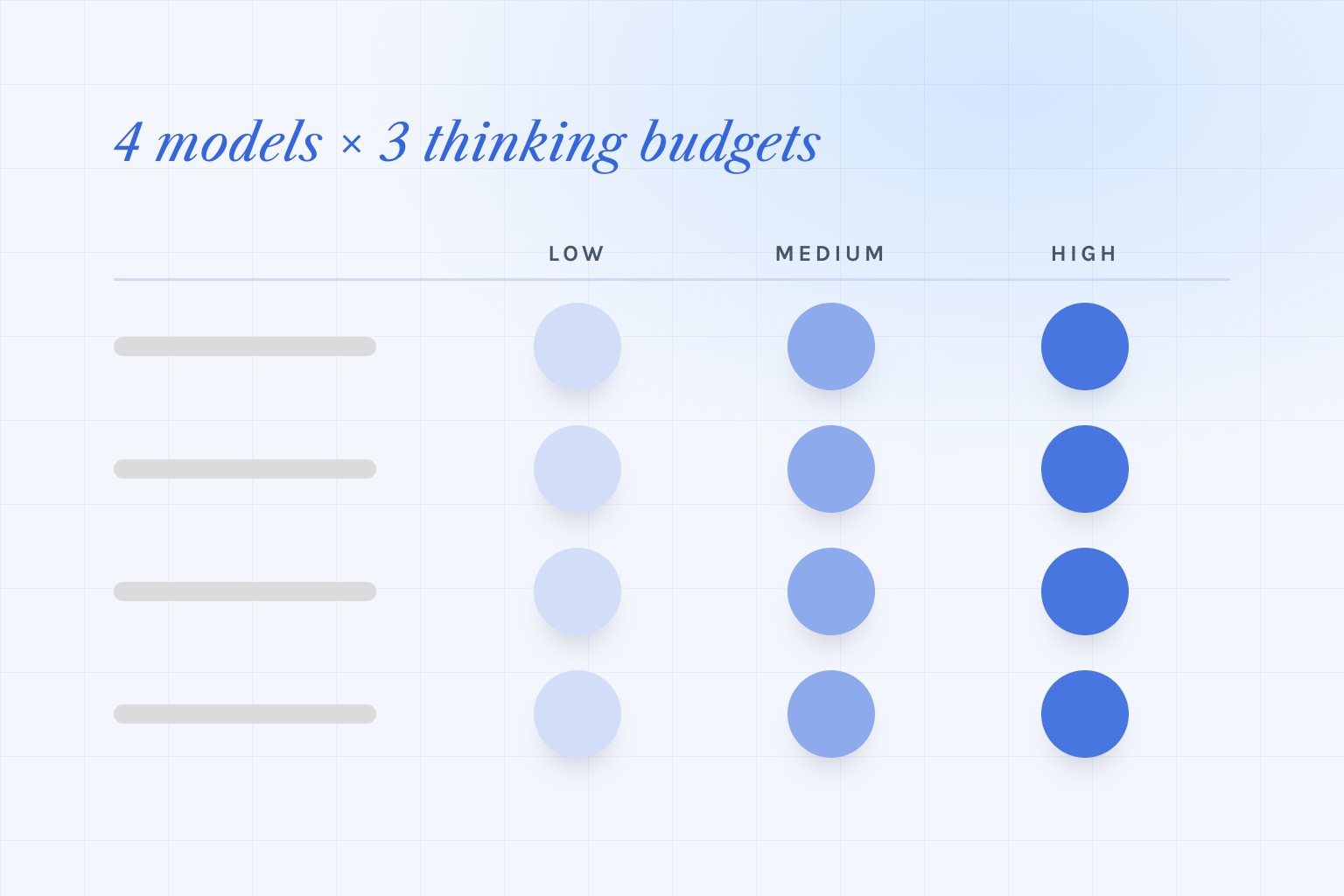
We ran Gemini 4 Hydrogen, Gemini 4 Neon, GPT-6.1 Terra and GPT-6.2 Sol on the same 36 commerce agent tasks as our October benchmark, each at Low, Medium and High thinking. The tasks cover product questions, order lookups, returns and customer replies. A task passes only when every tool and action check passes and an LLM judge scores the reply at least 4 out of 5.
As in our earlier runs, newer doesn’t automatically mean better here. Our agent acts as a brand advocate: it represents the store to its customers, recommends products, and has to be helpful, accurate and on-brand in every text. That’s quite different from coding or other tasks with a clearly verifiable answer, where most new models focus their gains. So newer or bigger models sometimes underperform older, cheaper ones on our work.
That held this time too. None of the four new models beat Gemini 4 Argon Medium from October, which passed 34 of 36. Neon did best at its lowest thinking level (32 of 36), and more thinking cost more without helping. Hydrogen, Terra and Sol landed at 29 to 31, close to the October Flash models, while costing more per task than 3.8 Flash.
More thinking didn’t reliably help either. Medium was the best setting for most models: it beat both Low and High for GPT-6.2 Sol, Gemini 4 Argon, 3.8 Flash and 3.7 Flash, and tied for best on Terra and 3.5 Flash. Neon, which peaked at Low, and Hydrogen, which peaked at High, were the exceptions.
Results
What each thinking budget buys
All 24 configurations on the same 36 tasks. Costs use public Standard rates for each provider, including advertised model promotions. October runs are repriced at November rates, so their costs differ from those in the Argon post.
L = Low · M = Medium · H = High · Hover a point for exact values, and click models in the legend to compare them.
Exact chart values
| Model family | Thinking | Agent cost/task | Passed | Pass rate |
|---|---|---|---|---|
| GPT-6.1 Terra | Low | $0.1033 | 30/36 | 83.3% |
| Medium | $0.1050 | 30/36 | 83.3% | |
| High | $0.1203 | 30/36 | 83.3% | |
| GPT-6.2 Sol | Low | $0.1950 | 30/36 | 83.3% |
| Medium | $0.1994 | 31/36 | 86.1% | |
| High | $0.2152 | 30/36 | 83.3% | |
| Gemini 4 Neon | Low | $0.2219 | 32/36 | 88.9% |
| Medium | $0.2855 | 30/36 | 83.3% | |
| High | $0.3694 | 29/36 | 80.6% | |
| Gemini 4 Hydrogen | Low | $0.1486 | 29/36 | 80.6% |
| Medium | $0.1590 | 30/36 | 83.3% | |
| High | $0.1809 | 31/36 | 86.1% | |
| Gemini 4 Argon | Low | $0.2381 | 32/36 | 88.9% |
| Medium | $0.1972 | 34/36 | 94.4% | |
| High | $0.2213 | 30/36 | 83.3% | |
| Gemini 3.8 Flash | Low | $0.0827 | 30/36 | 83.3% |
| Medium | $0.0904 | 32/36 | 88.9% | |
| High | $0.1167 | 30/36 | 83.3% | |
| Gemini 3.7 Flash | Low | $0.0840 | 29/36 | 80.6% |
| Medium | $0.0778 | 32/36 | 88.9% | |
| High | $0.0973 | 30/36 | 83.3% | |
| Gemini 3.5 Flash | Low | $0.1308 | 30/36 | 83.3% |
| Medium | $0.1652 | 30/36 | 83.3% | |
| High | $0.1802 | 28/36 | 77.8% |
OpenAI and Gemini benchmark results
36 tasks per row. Passes use the raw recorded grades. Latency is the median of recorded main-model call times.
| Model family | Thinking | Pass rate | Avg. judge / 5 | Agent cost/task | Median main call |
|---|---|---|---|---|---|
| 6.1 Terra | Low | 83.3% | 4.639 | $0.1033 | 3.31s |
| Medium | 83.3% | 4.639 | $0.1050 | 3.63s | |
| High | 83.3% | 4.611 | $0.1203 | 4.55s | |
| 6.2 Sol | Low | 83.3% | 4.750 | $0.1950 | 2.89s |
| Medium | 86.1% | 4.722 | $0.1994 | 3.29s | |
| High | 83.3% | 4.694 | $0.2152 | 3.77s | |
| 4 Neon | Low | 88.9% | 4.861 | $0.2219 | 5.74s |
| Medium | 83.3% | 4.806 | $0.2855 | 7.92s | |
| High | 80.6% | 4.722 | $0.3694 | 10.57s | |
| 4 Hydrogen | Low | 80.6% | 4.667 | $0.1486 | 3.46s |
| Medium | 83.3% | 4.667 | $0.1590 | 5.73s | |
| High | 86.1% | 4.833 | $0.1809 | 6.32s | |
| 4 Argon | Low | 88.9% | 4.861 | $0.2381 | 3.91s |
| Medium Highest pass rate in this sample | 94.4% | 5.000 | $0.1972 | 3.87s | |
| High | 83.3% | 4.750 | $0.2213 | 7.60s | |
| 3.8 Flash | Low | 83.3% | 4.694 | $0.0827 | 3.47s |
| Medium | 88.9% | 4.944 | $0.0904 | 5.30s | |
| High | 83.3% | 4.639 | $0.1167 | 9.34s | |
| 3.7 Flash | Low | 80.6% | 4.694 | $0.0840 | 4.26s |
| Medium | 88.9% | 4.750 | $0.0778 | 6.62s | |
| High | 83.3% | 4.778 | $0.0973 | 6.16s | |
| 3.5 Flash | Low | 83.3% | 4.639 | $0.1308 | 11.18s |
| Medium | 83.3% | 4.583 | $0.1652 | 6.71s | |
| High | 77.8% | 4.556 | $0.1802 | 18.77s |
Where the models differ
The 36 tasks fall into seven families. Each one tests a different part of being a good brand advocate over text.
- Customer reply quality (12 tasks): everyday judgment and tone. The agent handles complaints, missing deliveries, product feedback and questions like “am I talking to a bot?” with short, honest, natural replies, without pushing offers or inventing next steps.
- Return policy and confirmation (7): applying the store’s return and exchange rules correctly, and confirming the exact item, variant and outcome before anything is submitted.
- Purchase assistance (6): helping a shopper choose and buy, with recommendations, sizes, colors and links grounded in the live catalog, and knowing when to bring in a person.
- Product measurements (4): exact details shoppers ask about by text, like dimensions, fit and materials, taken from the product data instead of guessed.
- Catalog and shipping evidence (3): only claiming what the catalog and order data support, including whether an item ships to the customer’s country.
- Conversation ownership (3): replying when it should, staying quiet once a person has taken over, and following through on corrections.
- Support hours (1): telling customers when a person is available, without promising response times.
Results by task family
Tasks passed in Low / Medium / High order, on the same tasks for every model.
| Task family | Tasks | 6.1 Terra L / M / H | 6.2 Sol L / M / H | 4 Neon L / M / H | 4 Hydrogen L / M / H | 4 Argon L / M / H | 3.8 Flash L / M / H | 3.7 Flash L / M / H | 3.5 Flash L / M / H |
|---|---|---|---|---|---|---|---|---|---|
| Customer reply quality | 12 | 9 / 9 / 9 | 9 / 9 / 8 | 9 / 9 / 9 | 9 / 9 / 9 | 10 / 10 / 7 | 9 / 9 / 8 | 8 / 10 / 9 | 9 / 10 / 10 |
| Return policy and confirmation | 7 | 5 / 6 / 6 | 5 / 6 / 6 | 6 / 5 / 6 | 6 / 6 / 6 | 6 / 7 / 7 | 7 / 7 / 6 | 7 / 7 / 7 | 7 / 6 / 6 |
| Purchase assistance | 6 | 5 / 5 / 5 | 5 / 5 / 5 | 6 / 5 / 5 | 5 / 5 / 5 | 5 / 6 / 5 | 5 / 5 / 5 | 4 / 5 / 4 | 5 / 5 / 3 |
| Product measurements | 4 | 4 / 3 / 4 | 4 / 4 / 4 | 4 / 4 / 3 | 4 / 4 / 4 | 4 / 4 / 4 | 4 / 4 / 4 | 4 / 4 / 4 | 3 / 3 / 3 |
| Catalog and shipping evidence | 3 | 3 / 3 / 3 | 3 / 3 / 3 | 3 / 3 / 3 | 1 / 2 / 3 | 3 / 3 / 3 | 1 / 3 / 3 | 2 / 2 / 2 | 2 / 2 / 2 |
| Conversation ownership | 3 | 3 / 3 / 2 | 3 / 3 / 3 | 3 / 3 / 2 | 3 / 3 / 3 | 3 / 3 / 3 | 3 / 3 / 3 | 3 / 3 / 3 | 3 / 3 / 3 |
| Support hours | 1 | 1 / 1 / 1 | 1 / 1 / 1 | 1 / 1 / 1 | 1 / 1 / 1 | 1 / 1 / 1 | 1 / 1 / 1 | 1 / 1 / 1 | 1 / 1 / 1 |
Customer reply quality is the hardest family, and the newer models didn’t move it. No configuration passed more than 10 of 12. Argon at Low and Medium, 3.7 Flash Medium and 3.5 Flash at Medium and High reached 10. All four November models landed at 8 or 9 at every thinking level. Getting tone and judgment right in a short text is exactly the kind of skill that coding-style gains don’t carry over to.
Catalog and shipping evidence is where newer models clearly helped. Terra, Sol, Neon and Argon passed all three tasks at every thinking level. 3.5 and 3.7 Flash stopped at 2 of 3, and Hydrogen and 3.8 Flash only got there at higher thinking. The newer models were more careful not to claim things the data didn’t support.
Purchase assistance separates the top configurations. Most passed 5 of 6. Only Argon Medium and Neon Low passed all six, while 3.5 and 3.7 Flash slipped to 3 or 4 at High.
Returns favored the older Flash models. 3.7 Flash passed all seven at every level, and 3.8 Flash at Low and Medium. Every November configuration missed at least one, mostly the same check (more below), and Terra Low, Sol Low and Neon Medium missed two.
Product measurements, conversation ownership and support hours were close to the ceiling for every model. The few misses were scattered: 3.5 Flash missed one measurement task at every level, and Neon High and Terra High each lost a conversation-ownership task.
One return check compared two formats of the same product-variant ID. Hydrogen failed it on format alone at all three levels, and so did every OpenAI setting. All tables keep the raw grades. With only that ID format normalized, Hydrogen would score 30, 31 and 32 of 36 at Low, Medium and High. Terra would score 31 at every level, and Sol 31, 32 and 31.
A judge score of 5 can still come with a failed task, because a pass also requires every tool and action check to pass. Read average judge scores alongside the pass count.
Method
Each candidate model replaced the agent’s main model and the same set of supporting model calls. We varied the main model’s thinking level across Low, Medium and High. Most supporting calls ran at Medium, and the remaining components and the judge (Gemini 3.7 Flash High) stayed fixed. Every request had an 8,192-token output cap.
Customer turns were scripted, so no simulator model was involved. The agent read realistic catalog and order data, and all actions were captured rather than executed.
Each provider calibrates its own reasoning levels, so Low, Medium and High are not directly comparable across OpenAI and Gemini. OpenAI’s strict function-calling mode rejected some tool schemas with open objects or a choice among argument shapes. For those tools we used non-strict function calling with the same definitions, argument checks and grading rules.
The October results use an earlier version of the agent and data snapshot, and only the main model changed in those runs. Compare across months with that in mind. The November runs (Hydrogen, Neon, Terra and Sol) share the same agent version and grading checks.
Latency is the median of recorded main-model call times across all 36 tasks. A full customer reply can take longer, since the agent may call the model several times and wait for tools. A few main calls are missing timings (one in Hydrogen High, three in Argon High and four in Neon High). Those requests still count toward usage and cost.
Prompt caching by each provider can affect cost and latency, alongside the thinking level.
Each result comes from one run per task and configuration. One task moves the pass rate by 2.8 percentage points, so small differences are within noise. The Gemini judge may also favor its own model family.
Pricing
Costs use public Standard prices, including advertised model promotions. Agent cost includes the main model and supporting calls, and judging is excluded.
- Gemini: Google’s Standard prices as of November 13, 2026 (Neon as of November 18). Per million tokens, Hydrogen cost $1.50 for input, $0.075 for cached input and $7.50 for output including thinking. Neon cost $3.00, $0.15 and $15.00.
- OpenAI: OpenAI’s Standard prices as of November 23, 2026. Per million tokens, Terra cost $1.00 for input, $0.05 for cached input, $1.25 for 30-minute cache writes and $5.00 for output including reasoning. Sol cost $2.00, $0.10, $2.50 and $10.00. Both charge more for requests over 272,000 input tokens.